Romanian citizenship for Jewish descendants: the 1938 citizenship review, Bessarabia, and your passport
Prepared by the lawyers of the practice, which handles citizenship-by-descent cases (Legea 21/1991), including representation before the National Authority for Citizenship and the courts in Bucharest.
Reviewed by the practice's attorney, member of the Bucharest Bar (Baroul București) ·
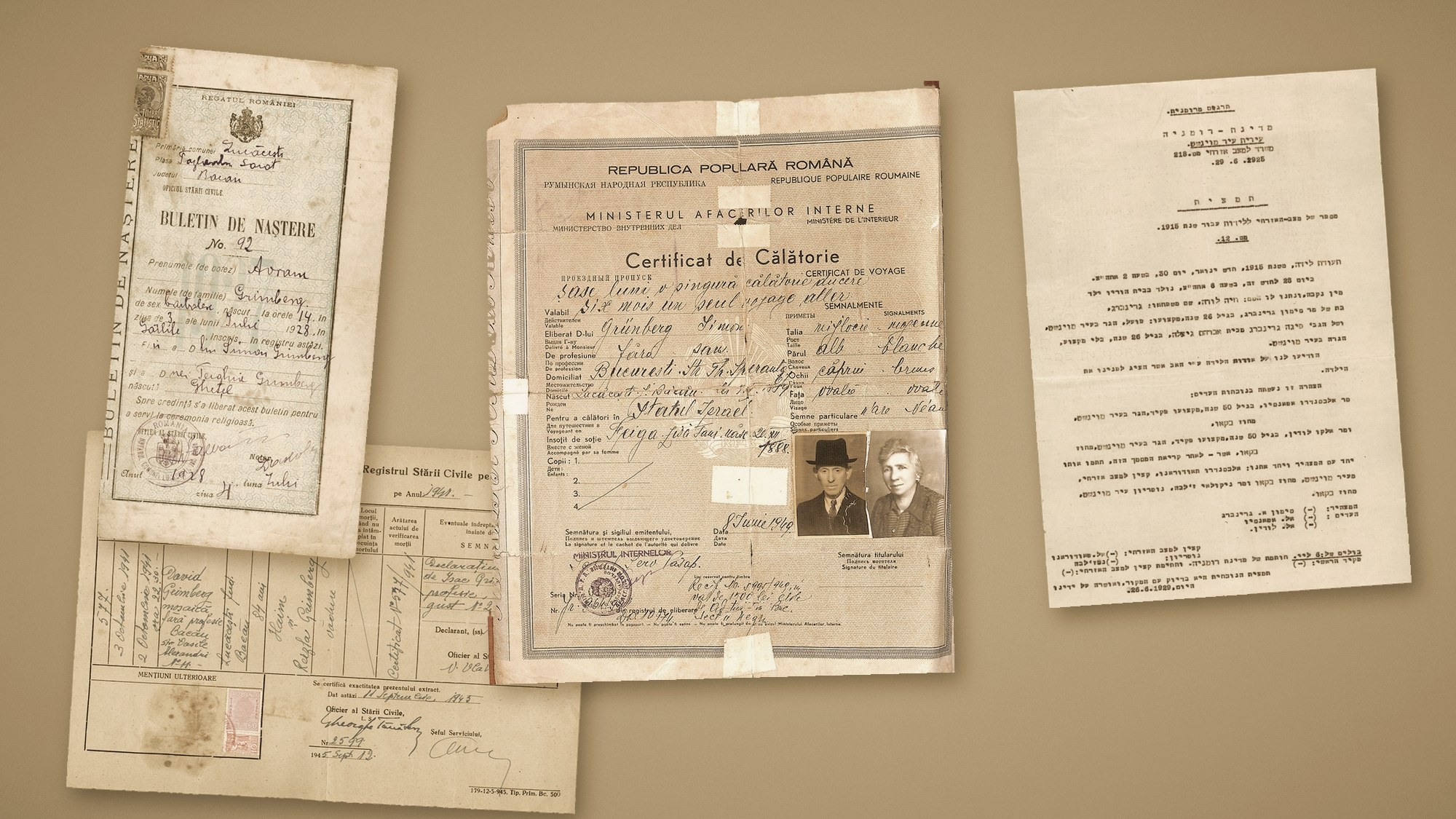
Many Jewish families in New York, London, Toronto or Haifa trace their roots to Iași, Bucharest, Chernivtsi, Chișinău or a small town in Bessarabia or Bukovina. Some of them have recently learned that this history may give them a right to Romanian citizenship, and with it an EU passport, and they want to understand how that works.
In many cases the family does have such a right. This article explains the legal basis for it, describes what happened to the citizenship of Romanian Jews in the 20th century, and sets out which rules apply to their descendants today. Throughout, it helps to keep one question in mind: how did your ancestor lose Romanian citizenship? The answer determines which article of the law applies and how many generations it reaches.
This guide is also available in Hebrew: איפה מסמכי הסבים מבסרביה ובוקובינה
Can Jewish descendants get Romanian citizenship?
Yes, on the same terms as anyone else. Romania has no special law for Jewish descendants or Holocaust survivors. Germany and Austria have such provisions, but Romania does not; a special law was announced in 2019 and was never passed.
Jewish families therefore apply under Romania’s general citizenship law, Law 21/1991, which offers two routes for descendants of former citizens:
- Article 11 covers people who lost Romanian citizenship for reasons that were not their fault, or whose citizenship was taken away without their consent, and their descendants up to great-grandchildren.
- Article 10 covers people who lost Romanian citizenship for any reason, and their descendants up to grandchildren.
Under both articles you keep your current citizenship, and you do not have to live in Romania.
The 1938 citizenship review
In January 1938 the Goga–Cuza government issued Decree-law No. 169 on the review of Jewish citizenship. A decree-law was an act adopted by the government that had the force of a law. Under this one, every Jew, however long the family had lived in Romania, had to submit papers proving citizenship within 40 days. Anyone who did not do so, or whose papers were judged insufficient, was declared a foreigner.
According to the International Commission on the Holocaust in Romania (known as the Wiesel Commission, which reported in 2004), 225,222 Jews lost Romanian citizenship in this review, in 73,253 families. In September 1938 those who had lost it were ordered to register as foreigners.
This history is directly relevant to descendants today. When the state took citizenship away against a person’s will, that is precisely the situation Article 11 was written for. A family whose citizenship was withdrawn in 1938 can therefore often claim under that article, which reaches great-grandchildren. For example, a woman in London whose great-grandparents in Chernivtsi were declared foreigners in the 1938 review would usually look first at Article 11.
1940–1944
In August 1940 Decree-law No. 2650 created a separate legal status for Jews, divided them into categories and barred them from many professions and forms of property. In May 1941 Jews whose citizenship had been revised, and Jews born in Bessarabia and Northern Bukovina, lost consular protection abroad, meaning that Romanian embassies and consulates would no longer act on their behalf.
During the war the Jews of Bessarabia and Bukovina were deported to Transnistria, a territory east of the Dniester river. The Wiesel Commission puts the number deported from Bessarabia, Bukovina, Dorohoi and the old Kingdom at between 154,449 and 170,737, and the number of those who died there by November 1943 at between 104,522 and 120,810. For the Iași pogrom that began on 29 June 1941, the Commission cites up to 14,850 dead.
We include these figures because they help explain why many families today have gaps in their documents, and why so many of them left the country after the war.
Bessarabia and Bukovina: nationality is not citizenship
Between 1918 and 1940 Bessarabia and Bukovina were part of Romania, and the Jews living there were covered by Romania’s 1924 citizenship law in the same way as everyone else. Records from that period often write “Jewish” (evreu) next to a name. That entry describes nationality in the sense of ethnic origin. It does not mean that the person was a foreigner, and on its own it does not break the family line.
How the 1918–1940 borders and the ancestor’s year of birth affect a claim is explained in was your grandparent a Romanian citizen.
Families who left after the war
According to the Romanian Embassy in Israel, about 118,000 Jews emigrated from Romania to Israel in 1948–1951 alone, and emigration continued for decades afterwards. From 1949 to 1989 Israel paid Romania for exit permits, the official permission to leave the country, as the historian Radu Ioanid documented in The Ransom of the Jews (2005).
Under a 1971 law, the communist state could withdraw citizenship from people who settled abroad and took another citizenship. Families who emigrated may therefore have lost Romanian citizenship when they left. Their children and grandchildren can apply. Whether the claim goes under Article 10 or Article 11, and therefore how many generations it reaches, depends on how the citizenship was lost. The difference between the two articles is explained in Article 10 or Article 11.
If the family never lost citizenship at all, you may already be a Romanian citizen, in which case what remains is to have that citizenship confirmed rather than to reacquire it.
Dual citizenship
Romania allows you to keep your other citizenship. Israel allows dual citizenship as well, with one practical rule: an Israeli citizen must enter and leave Israel on the Israeli passport.
The Romanian language requirement
Since 15 March 2025, applicants under Articles 10 and 11 must show knowledge of Romanian at B1 level, an intermediate level at which a person can handle everyday conversation. Two groups are exempt: people aged 65 or over, and former Romanian citizens reclaiming their own citizenship. Descendants under 65 are not exempt. Those who applied during the transition period may submit the certificate until 15 March 2027. The details are set out in the language requirement.
In practice, this means that a grandmother who left Romania herself, or any applicant over 65, can apply without the exam, while a grandson aged 35 will need the certificate.
Documents
Romania requires a birth record for each person in the line, together with marriage and death records where they apply, each issued within the last two years. Records issued outside Romania must also carry an apostille, a certificate that confirms a document is genuine for use in another country, and must be translated into Romanian.
Where the records are held depends on where the family lived. Records from Iași or Bucharest are kept in Romania, while records from Bessarabia and Northern Bukovina are kept in Moldova and Ukraine. Families deported east may have records in Russia or Kazakhstan. If your family came from Galicia, around Lviv or Kraków, that region was part of Poland between the wars, and the question is Polish rather than Romanian citizenship: see Polish citizenship by descent.
We obtain records from all of these countries, and we arrange their translation and apostille. How that works in each country is described in our article on family records.
The application itself is filed in person, either in Bucharest or at a Romanian consulate in the country where you live. If you file at a consulate, our lawyer can travel to you with the completed file and handle the filing with you, as described in applying in person.
Where to start
Begin by writing down what you know: the names as they were spelled at the time, the town, roughly when the family lived there, and when and where they left. Then photograph any document that has survived, such as a birth certificate, an old Romanian passport, an Israeli immigration card or a letter. Send these to us, and we will tell you which article applies and what the claim will need.
Common questions
- Is there a special Romanian law for Jewish descendants or Holocaust survivors?
- No. Unlike Germany and Austria, Romania has no separate provision, so Jewish families use the same two articles of Law 21/1991 as everyone else. Article 11 is the one that usually matters for them, because it covers people whose citizenship was taken away without their consent, together with their descendants up to great-grandchildren.
- My great-grandfather lost Romanian citizenship in 1938. Does that help or hurt?
- It usually helps. The 1938 review declared tens of thousands of Jewish families foreigners without their consent, and Article 11 covers exactly that situation, extending to the children, grandchildren and great-grandchildren of the person concerned. We review the family's records before confirming which article applies.
- Can I keep my Israeli or American citizenship?
- Yes, Romania lets you keep your other citizenship, and you do not need to live in Romania. Israel also allows dual citizenship, with the practical rule that Israeli citizens must enter Israel on their Israeli passport.
- Do I have to speak Romanian?
- Descendants under 65 need a certificate showing Romanian at B1 level, which is an intermediate level of everyday conversation. People aged 65 or over are exempt, and so are former Romanian citizens reclaiming their own citizenship. Those who applied in the transition period can submit the certificate until 15 March 2027.
- My family left Romania for Israel in the 1950s. Can I still apply?
- In many cases, yes. Families who left under communism may have lost Romanian citizenship when they emigrated, and their children and grandchildren, and in some cases great-grandchildren, can apply. Which article applies depends on how the citizenship was lost, so that is the first thing we check.
Tell us about your family
Send us the names, the town and the years your family lived in Romania, Bessarabia or Bukovina, and any documents that survived. We tell you which article applies and what the claim needs.
contact@origocitizenship.com · +40 759 128 902