Birth certificates from Ukraine, Moldova, Russia, Kazakhstan and Romania: getting your family's records for Romanian citizenship by descent
Prepared by the lawyers of the practice, which handles citizenship-by-descent cases (Legea 21/1991), including representation before the National Authority for Citizenship and the courts in Bucharest.
Reviewed by the practice's attorney, member of the Bucharest Bar (Baroul București) ·
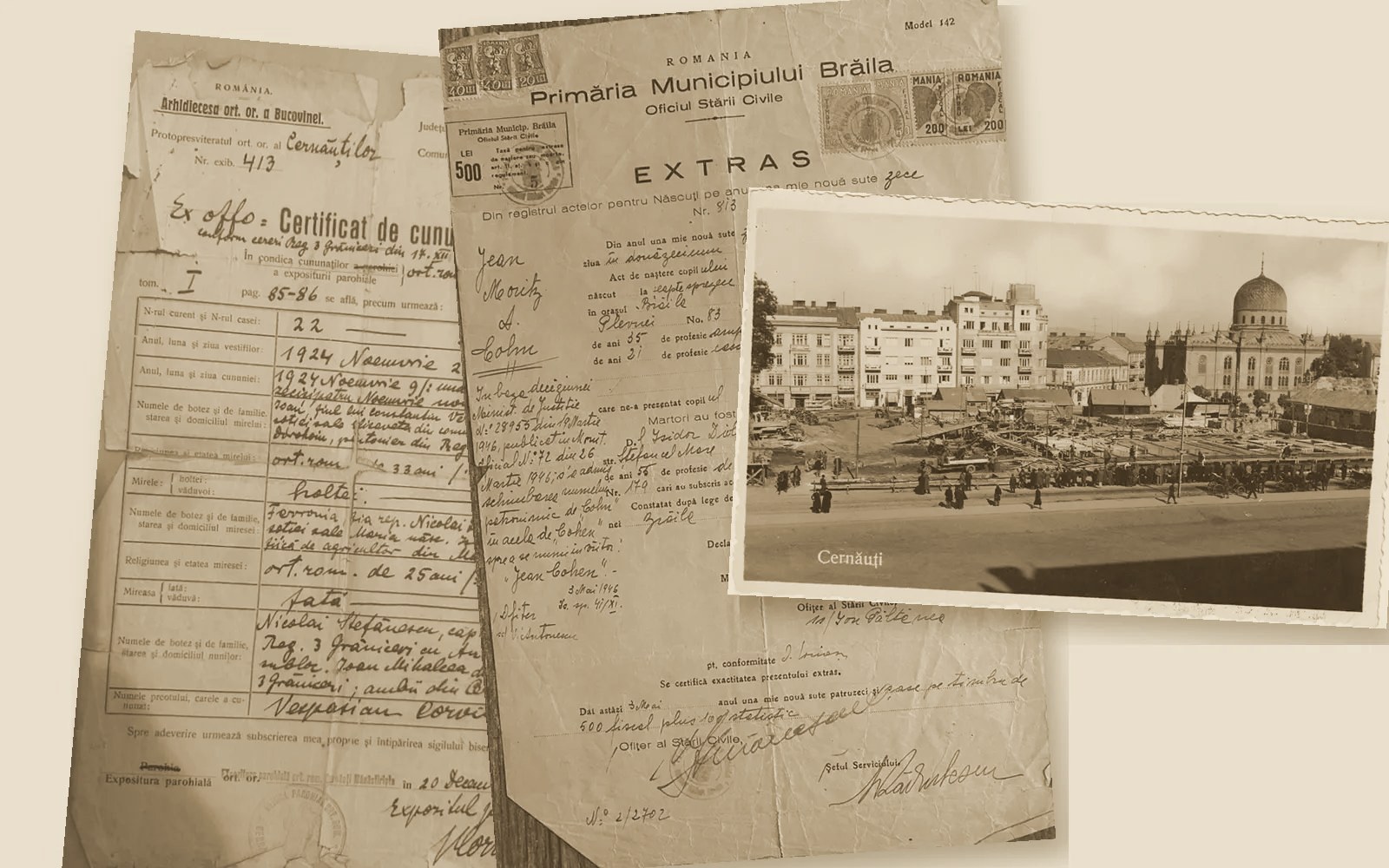
Romanian citizenship by descent is proved with paper: a birth, marriage or death record for each person between a former Romanian citizen and you. For many families these records are not in one place. They are spread across the countries where the family lived over the twentieth century, and today that can mean Ukraine, Moldova, Russia, Kazakhstan and Romania at once.
Here is a typical example. Your grandparents were born in Bessarabia. In 1941 they were sent to Kazakhstan, where your mother was born. She went to school in Russia and married in Ukraine, and you now live in Ohio or in London. Each of these events was registered where it happened, so each record is now held by a different country, under that country’s rules.
This article explains how each of the five countries issues these records, who is entitled to request them, and how they are translated and apostilled so that the Romanian authorities can accept them. We obtain such documents for clients from all five countries, and you do not need to travel for any of it.
Why are one family’s records spread across five countries?
The answer lies in the region’s borders and in the deportations of the Soviet period.
Between 1918 and 1940, Bessarabia and Northern Bukovina were part of Romania. People born there in those years were born in Romania, and their births were registered by Romanian authorities. In June 1940 the Soviet Union took both regions. Today most of Bessarabia is the Republic of Moldova, and Northern Bukovina is part of Ukraine.
The deportations followed. The main waves from Soviet Moldavia took place on 12–13 June 1941, 6–7 July 1949 and 1–2 April 1951.
In June 1941 people were selected according to the position they had held under Romania: officials and employees of the Romanian administration, police and courts, members of the interwar political parties, priests, officers, former members of parliament, large landowners and merchants, together with their families. All of them had been Romanian citizens before 1940, and this is why their descendants can often apply for Romanian citizenship today.
Kazakhstan was one of the main destinations in 1941. A Soviet camp administration report from autumn 1941 counted 22,648 people deported from the Moldavian SSR, of whom 9,954 were in Kazakhstan, in the Aktobe, Kyzylorda and South Kazakhstan regions (Aurelia Felea, New Europe College, 2021, based on the Central State Archive of Kazakhstan). In July 1949 about 35,800 people were deported, mostly to Siberia and the Far East: Tyumen, Kurgan, Irkutsk, Altai and Khabarovsk (National Archives Agency of Moldova).
Some of those released in the 1950s were not allowed to return home and stayed in Kazakhstan. The Soviet census of 1989 counted 33,098 Moldovans living there (Embassy of Romania in Astana).
In practice, this means that a family’s paperwork follows the family’s movements. A birth in Bessarabia in 1925, a marriage in Kazakhstan in 1955 and a death in Russia in 1990 were each registered locally, and each record has stayed in the country where it was made.
What does Romania need for citizenship by descent?
Romania asks you to show an unbroken line from a former Romanian citizen to you. For every person in that line you provide a birth certificate, and a marriage or death certificate where one applies. In addition, you need a police clearance certificate, which shows whether you have a criminal record.
The requirement that most often comes as a surprise concerns the age of the documents. Every civil record must be issued no more than two years before you file your application. This is set out in the requirements of Romania’s National Citizenship Authority (ANC) under Order 85/2025. Each document must also carry an apostille, which is the international certificate confirming that a public document is genuine, and it must come with a legalised translation into Romanian.
Why are Soviet birth certificates not accepted?
Many families have kept an old Soviet or USSR birth certificate, and it is a valid document in itself. The reason Romania does not accept it is simply its date: it was issued decades ago, so it falls outside the two-year rule. What is needed instead is a fresh certificate or extract from the office that holds the record now.
The same applies to any older certificate from Ukraine, Moldova, Russia or Kazakhstan. The old document is still worth keeping, because it shows where and when the record was made, and with that information the new request can be made much faster.
How do you get a Ukrainian birth certificate?
In Ukraine, civil registry offices (known by the abbreviation DRATsS) keep their register books for 75 years. After that, the books are transferred to the regional state archive.
Who may request a document depends on the type of document. A repeat birth certificate, meaning a new copy issued from the register, is given only to the person it concerns, their parents or their guardians, so grandchildren cannot request it. A death certificate can be requested by a wider circle of relatives, which does include grandchildren. For older records, and for the birth of a grandparent who has died, the state archive issues an archival certificate or extract instead. We explain the difference between these documents in detail in a separate article on ancestors’ records.
Apostilles on Ukrainian civil registry and archive documents are placed by Ukraine’s Ministry of Justice.
How do you get a Moldovan birth certificate?
In Moldova, duplicates of birth, marriage and death certificates are issued by the civil status offices and by the Registers Archive of the Public Services Agency (Law No. 100/2001, Article 8). They can be requested by family members, by relatives of a deceased person, and by a representative with a notarised power of attorney. How such a power of attorney is signed abroad and apostilled, both for Ukraine and for Moldova, is explained in power of attorney for Ukraine.
Register books stay with the civil status office for 75 years and are then transferred to the Registers Archive. Archival certificates are issued by the National Archives Agency.
Moldovan documents can be apostilled only in Moldova, by the Ministry of Justice. If you request a duplicate through the Moldovan embassy in the US, the embassy states that it takes two to three months.
How do you get a Russian birth certificate?
In Russia, a repeat certificate is issued by the civil registry office (ZAGS). If the person has died, the certificate can be requested by a relative or by another person with a legitimate interest (Federal Law 143-FZ, Article 9). A representative with a notarised power of attorney can also apply.
Russian civil registries keep their books for 100 years, which means that records made after 1926 are still held by ZAGS rather than by an archive. The apostille is placed by the regional civil registry authority, and for archival documents by the regional archive authority.
How do you get a Kazakhstan birth certificate?
In Kazakhstan, repeat certificates are issued by the registration offices and by Kazakh embassies and consulates abroad (Code on Marriage and Family, Article 178). A repeat death certificate is issued to close relatives and heirs, and the application must include documents that prove the family relationship.
Register books are kept for 75 years at the place where the event was registered and are then transferred to the state archive. Apostilles are placed by the Ministry of Justice and its regional departments.
For families deported in 1941, Kazakhstan is often where a missing link in the line is found: a marriage, the birth of a child or a death that took place in exile.
How do you get Romanian birth records?
Some records are held in Romania itself. This is the case for ancestors born in Transylvania, Banat or the old Kingdom of Romania, and for events registered in Romania later on. Certificates are issued by the civil status office of the town hall that holds the register. After 100 years the registers are transferred to the National Archives, which continue to issue certificates from them.
A Romanian birth certificate is issued to the person it concerns or to someone holding a special power of attorney, and a power of attorney signed abroad needs an apostille. The apostille on a Romanian certificate can be placed by any county prefect’s office.
Police clearance certificates
The Romanian application also requires a police clearance certificate. We obtain these from Ukraine, Moldova and Romania.
How can you get the documents without travelling?
The key document here is the power of attorney. All five countries, as well as the US and the UK, are members of the Hague Apostille Convention. Because of this, a power of attorney signed in one of these countries can be used in another with an apostille alone, and the process is straightforward:
- We tell you which documents your case needs and who is entitled to request each one.
- You sign a power of attorney, either before a notary where you live, followed by an apostille, or at the consulate of the country concerned.
- Our representative applies to the registry office or archive in that country.
- The document is issued, apostilled and translated.
- We send it to you, or file it directly in your case.
It is important to establish who signs. Sometimes it is you, and sometimes it is your parent, because the law allows only certain relatives to request a particular certificate. We check this before anyone signs a power of attorney, so that each request is made by the person entitled to it.
Translation and apostille in one package
When people look for a Ukrainian or Russian birth certificate, they almost always need the translation and the apostille as well, because the document has to be usable in another country. We take care of the whole sequence:
- Obtaining the document from the registry office or archive in Ukraine, Moldova, Russia, Kazakhstan or Romania.
- Translation into any language: into Romanian for the citizenship file, into English for use in the US or the UK, or into another language. The translation is done in Ukraine, Moldova or Romania, depending on what suits the document best.
- The apostille, in the country that issued the document.
- Delivery to your address, or directly into your Romanian citizenship file.
- Anything else the document needs, from correcting a misspelled name to a second copy for another purpose.
The citizenship application itself is filed in person, either in Bucharest or at a Romanian consulate in the country where you live. If you file at a consulate, our lawyer can travel to you with the completed file and handle the filing together with you, as described in applying in person.
What does it cost?
- Ukraine and Moldova: quoted per record before any work starts — how pricing works.
- Russia and Kazakhstan: on request.
- Romania: on request, once we have seen your documents and know exactly what needs to be obtained.
Tell us whose records you need
Attach whatever the family kept: a photo of an old certificate, a passport page, a letter with an address. We reply with what can be obtained, where, and the cost.
Where to start
A good first step is to write down what you know about each relative: their names as they were spelled at the time, the places as they were called then, and approximate years. Then take photos of any papers that have survived and send everything to us. From this we can work out which records exist and where they are held.
If you are not yet sure whether you qualify, it helps to read what an eligibility check examines and how Article 10 and Article 11 differ. If the line of Romanian citizenship in your family was never broken, you may already be a Romanian citizen.
Common questions
- Will Romania accept my grandmother's old Soviet birth certificate?
- No. For Romanian citizenship by descent, every birth, marriage and death record must have been issued by the authority no more than two years before you file. An old Soviet certificate was issued decades ago, so however well it has been kept, it cannot meet this rule. A new certificate or extract is therefore requested from the office that holds the record today.
- Can I get a Russian birth certificate for a relative who has died?
- Yes, in most cases. Russian law allows a relative of the deceased, or another person with a legitimate interest, to request a repeat certificate from the civil registry (Federal Law 143-FZ, Article 9). You do not need to go to Russia for this, because the request can be made through a representative with a power of attorney or through a Russian consulate.
- Do I have to travel to Ukraine, Moldova or Kazakhstan myself?
- No. The documents are requested by a representative who acts under your power of attorney, or through that country's consulate where you live. You sign the power of attorney before a notary in the US or the UK, where it receives an apostille, or you sign it at the consulate.
- Which language will the translation be in?
- Any language you need. For Romanian citizenship the translation must be into Romanian and legalised. If the same document is also needed in the US, the UK or elsewhere, we translate it into English or another language as well. The translation can be done in Ukraine, Moldova or Romania.
- How long does it take?
- It depends on the country and on how old the record is. For example, the Moldovan embassy in the US gives two to three months for a duplicate requested through it. Once we know which office holds each record, we can give you a realistic estimate for your case.
Get a price for your family's documents
Tell us whose records you need and where the family lived. Attach whatever you have, even a photo of an old certificate. We reply with what can be obtained, from which office, and the cost.
contact@origocitizenship.com · +40 759 128 902